ARU Sharemarket Manipulation

We can't expect the Regulators to get off their backsides and actually do anything unless they are forced too. ASIC is beheld to the Brokers who run the ASX. I thought High Frequency trading by Algo's to manipulate the course of sales had been banned, apparently not. China thru its proxies have now demonstrated that they can use HFT to control the stock markets,

The only way to force ASIC to take action will be to embarrass Albanese, unfortunately it seems that the mum & dad Australian voter have no leverage, Only Donald can do that, so he has to be made aware of this situation that can scupper his Goal.
 
A small, per trade tax/levy would destory all this algo trading and manipulation. And also fund ASIC to go after all the insider/institution illegal practices.

We need a campaign to write to all ministers.

We also need a really easy way to explain it...so that non financial people can understand.
 
I came across this UBS piece on another forum.
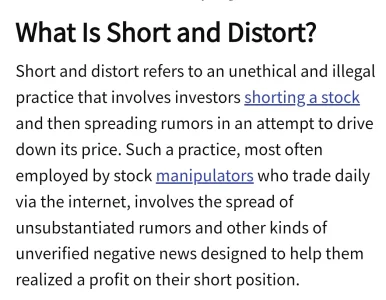
I don't 100% know what positions UBS has myself as I do not have access to the data, but if they do hold short positions in ASX listed rare earth stocks then I would think this is a clear cut case of "short and distort" is it not?

https://www.afr.com/markets/commodi...laying-the-rare-earths-sector-20251031-p5n6pj

1762253702657.webp

There are only two points here:

1) They have a short position (true or false)
2) Providing it has originated from the shorter, this press is intentionally spreading negative market sentiment (market commentary that is opion not actual fact) with the intent of subduing buying (true or false)

If the answer to both of these is true then I see it as pretty clear cut.
 
Last edited:
Market manipulation is when someone intentionally pushes a share price up or down to benefit themselves – without the price moving for genuine market reasons.

It’s illegal.

Shorting a stock is NOT automatically manipulation.

Shorting is legal.

Manipulation is about artificially creating a false price or false market activity.

ASIC requires listed companies to have a process for detecting market manipulation and must report suspicious activity – especially if someone is:
  • trading while holding inside information, or
  • trading in a way that creates a fake/false price or fake volume.

How do people/institutions artificially influence a share price?

These are the most common techniques:
Technique
Plain English meaning
Simple example
Painting the TapeMaking lots of tiny trades to make it look like there is a trend or big activitySomeone sells 1 share, 1 share, 1 share to push price down 0.5c steps. Triggers fear.
Wash SalesTrading with yourself (or related accounts) to move the price even though ownership doesn’t really changeAccount A sells to Account B (same owner) to walk price lower.
Matched OrdersTwo colluding parties place buy & sell orders at same price/size to set a fake reference priceTwo hedge-fund accounts “agree” to transact 50,000 shares at a lower price to set a new price point.
Marking the CloseDumping shares right at the end of the day to force a weak closing pricePrice is $0.25 all day, then someone sells 20,000 shares at 4:09:59pm at $0.235 to force a weak close.
Retail investors mostly don’t do this – it is done by sophisticated traders with capital, automation and scale.

Why do large traders have an advantage?

Large investment banks + hedge funds often:
  • mount their servers next to ASX servers (co-location)
    – cost ~$500k–$750k/year
    – gives them micro-second speed advantage
  • pay almost nothing per trade
    – retail might pay $15–$25 per trade
    – institutions can trade millions of tiny parcels for almost $0 cost
So they can:
  • sell 1 share at a time to push price down
  • use algorithms to detect when retail starts buying … and instantly place blocks above them to slow momentum
This is why retail investors might feel like a stock “keeps being held down” despite good news.

Is the market fair?

Not really.

The structure of the trading technology itself gives a huge advantage to banks and funds.
A potential solution (example idea):

A flat tax per trade (e.g. 10% of share price = 20c on a $2 stock)

This would barely affect retail (who trade occasionally), but would destroy the business model of “manipulating with tiny micro-trades”.

Money raised could also help increase ASIC’s enforcement budget.

Summary​

  • Manipulation = artificially forcing a price up or down (illegal)
  • Shorting = legal (unless done with manipulation techniques)
  • Large players can push prices around because they have:
    • speed advantage
    • near-zero trading cost
  • Retail investors see the end result (price flat or falling) – not the micro-structure behind it
 

Here is the website for all Australian Ministers and their emails:​

https://www.aph.gov.au/Senators_and_Members/Contacting_Senators_and_Members

Also send to:

Finance.reps@aph.gov.au
economics.reps@aph.gov.au

COPY / PASTE EMAIL TEMPLATE​

Subject: Urgent – suspected market manipulation in [INSERT COMPANY NAME] – request for Ministerial action

Dear Minister,

I am writing as a retail investor and a voting Australian citizen.

I wish to formally raise a concern regarding suspected market manipulation in the ASX-listed company [INSERT COMPANY NAME].

From observing the live market depth and trade data on the ASX each day, the share price of this company appears to be influenced by trading patterns that do not reflect fair supply and demand – but instead appear consistent with several well-known manipulation techniques.

Examples of manipulation techniques that MAY be occurring include:
Painting the Tape – many small trades (sometimes even 1 share) repeatedly placed to push the price down, creating negative sentiment and triggering retail stop-losses
Wash Sales – related parties trading back and forth with no real change in ownership, to move price
Improper Matched Orders – colluding buy/sell orders at the same size and price used to “set” a false price where genuine order book depth is thin
Marking the Close – last-minute dumping at 4:09pm to force a weaker daily close, influencing sentiment and chart patterns


These patterns (which would be confirmed by investigation if a proper investigation was performed) are illegal under ASIC rules – they artificially move price and mislead the market.


I also remind you:
• retail investors pay brokerage on every trade
• large funds and brokers often pay near-zero, and even co-locate servers beside the ASX for micro-second speed advantage

This creates an unfair and unequal market structure that overwhelmingly harms everyday Australians who are trying to responsibly invest and grow long-term wealth.

The problem is this:

ASIC and ASX do nothing.​


Despite years of repeated examples and thousands of retail complaints across social media, forums and direct investor contact – nothing changes.

This is damaging retail investors, superannuation returns, and confidence in Australian capital markets.

Retail investors are voters.

I request a written response from your office confirming:
  1. that no market manipulation is occurring in this company (if that is the Government’s position), or
  2. what action the Minister will take to ensure ASIC properly investigates these behaviours
This is a serious matter, and Australians deserve a market that is genuinely fair and free from artificial price interference.

I look forward to your direct reply.


Yours sincerely,
[YOUR FULL NAME]
 
Back
Top